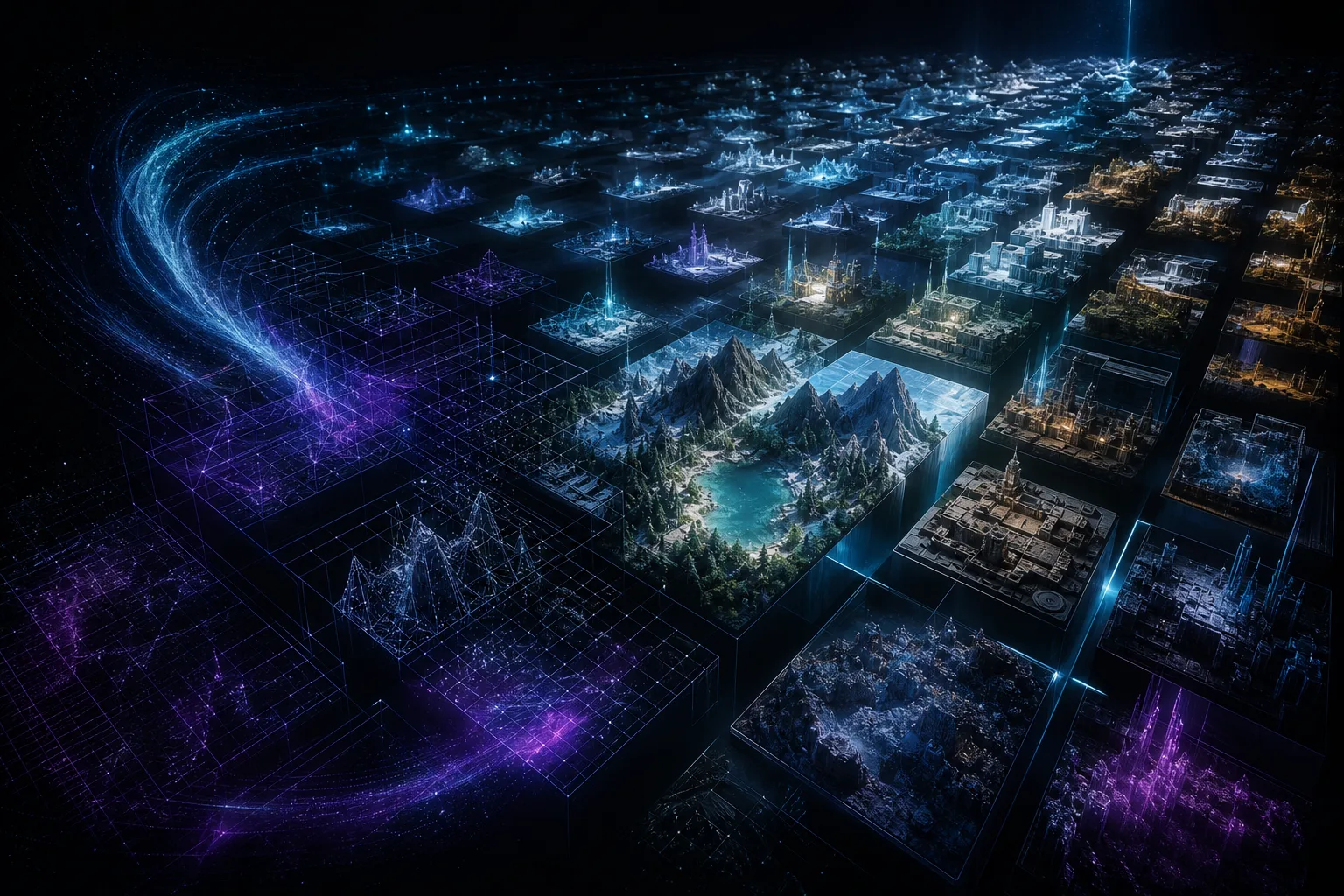
This project sets out to solve the "data hunger" and "long-tail scenario" problems of AI training. UsingPCG (procedural content generation), we have built a virtual world generation engine that is unbounded in scale, physically plausible and semantically rich, supplying AI models with a continuous stream of training data.
Why a PCG + DCC pipeline
1. A shift in paradigm: from making one asset to running a production process
PCG + DCC is not a tool-level replacement for a traditional art pipeline. It restructures the logic of production itself, which is a paradigm-level shift.
A traditional pipeline centres on making one model;PCG + DCC centres on building a standardised, reusable production process, where the model is simply what that process outputs.
Traditional pipeline: one investment of effort produces one model. The labour and time per asset are essentially fixed, total cost accumulateslinearlywith count, and the larger the production run the higher the total spend.
PCG + DCC pipeline: build the process once, then trigger it to produce batches of assets that all meet one standard. The pipeline is a one-off investment,the marginal cost of an additional asset approaches zero, and unit cost keeps falling as output grows — so the larger the run, the more the gap over asset-by-asset modelling widens byorders of magnitude.
The table below grounds that "marginal cost approaching zero" in concrete dimensions, expressed as ratios and trends rather than invented absolute hours:
| Dimension | Modelling one asset at a time | Ours (PCG + DCC) |
|---|---|---|
| Cost of an additional asset | Accumulates linearly with count, unit cost fixed | Build the pipeline once; the marginal cost of another asset approaches zero |
| Returns to scale | The larger the volume, the higher the total spend | The larger the volume, the lower the unit cost (an order-of-magnitude advantage) |
| Changing conditions in bulk (season / weather / material) | Manual rework asset by asset | Change a parameter, update everything, done in minutes |
| Reuse across projects | Mostly rebuilt from scratch | Process, templates and parameters reuse directly |
| Consistency of simulation fidelity | Depends on people, varies | One fidelity baseline, no variance |
2. Dynamic configuration: from static files to parameterised control
A traditional pipeline delivers static model files, so adjusting a batch means a modeller editing each asset by hand — repetitive labour by nature. A PCG + DCC pipeline delivers dynamically configurable files, so adjusting a batch means changing a parameter in the pipeline and triggering an update across every asset, done in minutes.
3. Fit for simulation: reuse across projects, iteration across conditions, construction at scale
A PCG + DCC art pipeline matches what digital simulation scenes actually need. Every asset produced in bulk conforms strictly to one simulation-grade fidelity baseline, with no variance. On that basis it delivers:
- Reuse across projects: the standardised process framework, asset templates and technical parameters already built can be reused directly on another project, with no need to rebuild the production pipeline each time, which cuts duplicated development time and effort and shortens the ramp-up of a new project.
- One-click condition changes: when conditions change — season, weather, material — parameters are configured once and the adjustment applies across every scene and every asset, rather than editing assets one by one.
- Construction at scale: very large, fully hierarchical complex scenes such as a smart-city environment can be built and managed efficiently, compressing the time to stand up a large-scale scene compared with a traditional pipeline.
Walkthrough video
PCG scene generation walkthrough
Technical examples
A city-scale construction engine
City-scale scenes in one pass: road networks, buildings and the natural environment take shape automatically while satisfying rule and diversity constraints:
- Road network generation: complex networks that obey traffic rules, including interchanges, roundabouts and intersections.
- Building growth: building modules combined automatically by district function, commercial or residential, balancing stylistic diversity against plausibility.
- Natural environment fill: vegetation, rock and water distributed automatically to reproduce real terrain.
Every element under control
We do not only generate static scenes; we hand over agod's-eye viewof the environmental elements, so corner cases can be attacked deliberately:
- Weather system: precise control of rain (standing water depth), snow (coverage thickness), fog (visibility distance) and wind strength.
- Lighting system: sunlight simulated for any latitude, longitude and time of day, plus interference from artificial light sources in a city at night.
- Dynamic traffic: vehicles and pedestrians with interactive behaviour, such as a pedestrian emerging from behind an obstruction or an illegal lane change, to train an AI's emergency response deliberately.
Proving the value: Sim2Real
To make sure a model trained in the virtual environment transfers to the real world, we apply severaldomain randomisationstrategies:
- Texture randomisation: object material textures are swapped at random, which stops the model overfitting to particular texture features.
- Lighting randomisation: light colour, intensity and direction are varied at random.
- Sensor noise simulation: real camera distortion, noise and motion blur are modelled, along with the point-dropout characteristics of LiDAR.
Measured results: training on a dataset mixed with 30% PCG synthetic data raised object detection mAP by15%, with markedly better robustness under extreme conditions such as rain and snow.
Where it applies
- Autonomous driving: perception algorithm pre-training, planning and control policy validation, end-to-end driving simulation.
- Embodied intelligence: indoor robot navigation, manipulator grasping, quadruped terrain adaptation.
- Smart cities: rapid construction of a large-scale city base layer, emergency response rehearsal, traffic planning simulation.
Example: a licence plate generation platform
Take the licence plate synthetic data platform: an engineered process turns a business requirement into areusable, deployabledeliverable, joining up data generation, noise control, online 3D visualisation and export. The process can be replayed and reproduced, and it integrates smoothly into an existing site.
Live demo:Licence plate generator